

Your Road Test Is Two Weeks Away. Here Is How to Use the Time.

Two weeks sounds like enough time. For most students, it is. The question is whether those two weeks produce the kind of practice that actually changes outcomes, or just more hours behind the wheel doing the same things the same way.
The habits that fail road tests are not usually new problems. They are old ones that were never fully corrected. With two weeks left, there is still time to find them and fix them. There is not enough time to keep practicing the things you already do well.
Week One: Find the Gaps
The first week is diagnostic. Your job is to identify exactly which habits are not yet automatic, not to accumulate hours.
Drive with someone who will give you honest feedback
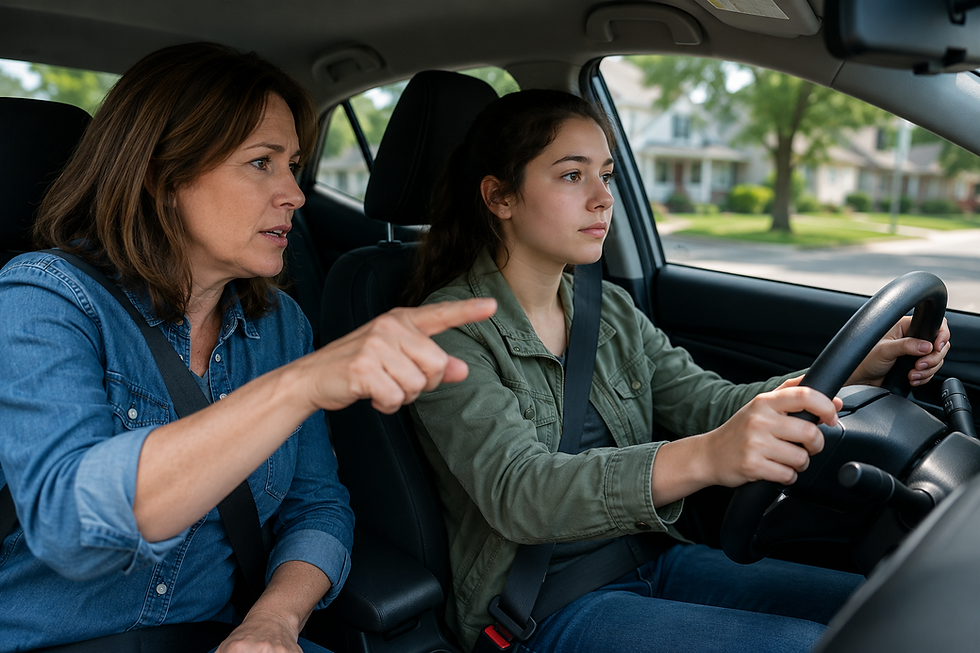
Parents are the most common practice partner and the least reliable source of accurate feedback. Not because they do not care, but because they have been driving for 20 years and no longer notice the habits the examiner marks. A rolling stop feels like a stop. A mirror glance feels like a check. If the only feedback you are getting is from a parent who thinks you are ready, you may be missing the specific things that cost points.
A lesson with a certified instructor in week one does something parent practice cannot: it identifies the actual gaps. An instructor watching from the passenger seat with a clear sense of what the score sheet requires will find things in a single 45-minute session that months of parent practice missed.
Focus your self-assessment on observation and stops
If you are practicing without an instructor this week, ask whoever is riding with you to specifically watch two things: whether your head moves visibly on mirror checks, and whether the car comes to a complete stop before you look and proceed at signs. These two habits generate more lost points than almost anything else on the score sheet. If either one is inconsistent, that is where the week needs to go.
Practice at the right times of day
Most road tests are scheduled during weekday business hours. If all of your practice has happened on quiet Saturday afternoons, you have not practiced in the conditions you will actually face. Morning traffic and school drop-off zones are different environments than a relaxed weekend drive. Get at least a few sessions in during weekday morning hours this week.
Week Two: Lock It In
The second week is not the time to learn new things. It is the time to make sure the things you have been working on are consistent enough to hold up under pressure.
Simulate the test, do not just practice driving
There is a difference between driving around and running a simulated test. A simulation means 15 minutes of continuous driving on unfamiliar roads, with someone in the passenger seat who does not help, does not prompt, and does not reassure. You are on your own to make every decision.
Run the simulation on roads you do not know well. The examiner will direct you turn by turn. You will not know the route in advance. A student who has only ever practiced on familiar streets has never had to process an unfamiliar road, follow verbal directions, maintain observation habits, and manage nerves all at once. That is exactly what the test requires.
Do not over-practice parallel parking
Parallel parking gets disproportionate attention in the final week because it is the most visible and concrete skill to drill. It is also worth fewer points than most students assume. An imperfect park that stays within 18 inches of the curb is not a failed test. A student who spends six hours on parallel parking and neglects observation habits and intersection sequencing has made the wrong trade.
Practice parallel parking until it is controlled and repeatable. Once it is, move on. Spending the week's last sessions running it again and again does not build on what you have. It just uses time that could close a more expensive gap.
Stop practicing two days before the test
Many instructors recommend taking the final couple of days before the test to rest rather than squeezing in one last practice session. Two days off does not erase what you have built. It means you arrive rested, not wrung out from a session that did not go well the night before.
A bad practice run the day before a test does more psychological damage than it does practical good. Whatever did not work in that session will not be fixed in 45 minutes. What stays with you is the frustration, not the progress.
What to Confirm Two or Three Days Before the Test
Your learner permit needs to be valid and unexpired. Bring the physical card, not a mobile ID, which the DMV does not accept at road test sites.
Your pre-licensing certificate needs to be current. If you completed the 5-hour pre-licensing course, bring your MV-278 certificate. If you completed a state-approved high school or college Driver Education course, bring your MV-285 certificate instead. Either way, the certificate expires one year from the date it was issued. If it has lapsed, you will not be permitted to test.
The vehicle needs to be registered, inspected, insured, and in clean condition. The examiner will check the vehicle before the test begins. Brake lights, turn signals, windshield wipers, and the horn all need to be working. If the vehicle fails the pre-test check, the test does not happen.
If you are under 18, you need a completed MV-262 Certificate of Supervised Driving signed by a parent or guardian, presented to the examiner at the time of the test. The driver who brings you must be over 18 if they drove you to the site, or over 21 if you drove yourself there.
The morning of the test, check the NY DMV cancellations page before you leave. The DMV posts weather-related cancellations and site closures at dmv.ny.gov. If your test is canceled, the DMV will reschedule it at no charge.
The Morning of the Test
Arrive up to 15 minutes before your scheduled time. If you are late, the examiner may not be able to conduct the test and you will need to reschedule. Bring your valid NYS photo learner permit and your MV-278 or MV-285 certificate. Results are not given on the spot. After the test, the examiner will direct you to
roadtestresults.nyrtsscheduler.com, where your results will be posted after 6 p.m. on test day.
Treat the examiner as a passenger, not an evaluator. They are going to give you directions. Follow them, drive the way you practiced, and do not try to perform. The students who pass are not the ones who drive perfectly. They are the ones who drive steadily.
Road Test Prep at All Care Driving School in Hicksville and Ronkonkoma
If you have two weeks until your road test and are not sure whether your habits are solid enough to hold up, one or two targeted lessons with an All Care instructor will tell you directly. We prepare students for the roads and traffic conditions in Nassau and Suffolk counties, and we know what the score sheet measures. Our instructors are DMV-certified and one-on-one, with lessons available from both our Hicksville and Ronkonkoma locations, including free pickup and drop-off. Two weeks is enough time to make meaningful improvements when you know what to work on.
Contact All Care Driving School
Schedule road test prep lessons at either of our Long Island locations.
Hicksville: (516) 605-0033
Ronkonkoma: (631) 724-3488
Email: allcaredriving@gmail.com


Comments