
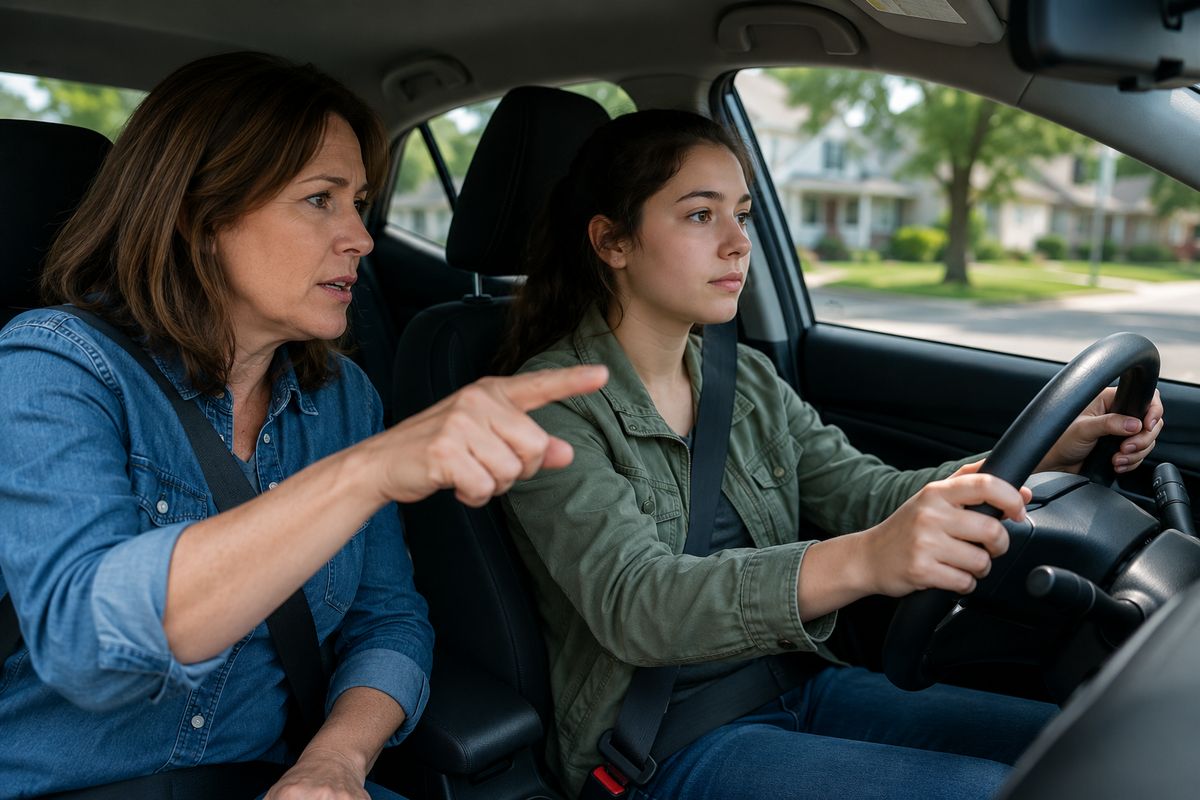
If you have been driving for 20 years without an accident, you are a good driver. You may also be teaching your teenager habits that feel completely normal in everyday driving but can cost points on a New York road test.
That is not an insult. It is how driving works. Over time, safe driving becomes automatic, and some of the visible habits the DMV expects during a road test quietly fade. You stop making your mirror checks obvious. You make judgment calls at yellow lights that a new driver may not know how to evaluate yet. You ease through familiar intersections in ways that feel perfectly normal after years of driving.
When you teach those habits to your teenager, you are not teaching them to drive. You are teaching them to drive the way you drive, which is a different thing entirely from what the road test evaluates.
How the New York Road Test Is Actually Scored
The NY State road test uses a point system. You start at zero and accumulate points for errors. Stay at 30 points or below, and you pass. Hit 31 or more, and you fail. Certain actions, like running a red light or requiring the examiner to intervene with the vehicle, end the test immediately, regardless of the point total.
Errors run from 5 points for minor infractions up to 15 points for serious ones. The score sheet covers five categories: leaving the curb, turns and intersections, driving in traffic, use of controls, and general operation. A teenager can fail by making a handful of moderate errors that most experienced drivers make on every single commute without thinking about it.
The Specific Habits Parents Pass Down That Examiners Mark
Mirror Checks That Look Like Mirror Checks
Experienced drivers glance at mirrors constantly. They just do not do it in a way that is visible to anyone watching. A quick flick of the eyes takes milliseconds and gets the job done without any head movement.
That is not what the examiner is looking for. The road test requires deliberate, observable mirror checks: mirrors before signaling a lane change, mirrors plus a head turn to cover blind spots, and a full scan before backing up. The check has to be visible. An examiner sitting in the passenger seat cannot see your eyes. They watch your head. If your head does not move, the check does not count.
Most parents teach their kids to check mirrors without ever demonstrating what an observable mirror check looks like, because they stopped making observable ones years ago.
The Rolling Stop
Ask any honest driver whether they come to a complete stop at every stop sign. The answer is almost never yes. A slow roll through a quiet intersection with a clear sight line feels like a stop. It is not a stop. The wheels are still moving.
On the road test, a rolling stop is a marked error. A complete stop means the vehicle is fully motionless before you look and proceed. Teenagers who practice with a parent who rolls through stops learn to roll through stops. On test day, that habit costs points. If it happens at multiple signs during a 15-minute test, the total climbs fast.
Following Distance
The NY DMV recommends a minimum two-second following distance under normal conditions. Following too closely is a 10-point infraction on the score sheet. Most adult drivers maintain far less than two seconds in normal traffic because traffic moves in a compressed pack, and keeping two full seconds of space means someone will fill it.
Most teenagers copy what their parents actually do in traffic, not what the handbook says. The gap between everyday driving habits and road test expectations is often wider than parents realize.
Speed in Parking Lots and Residential Streets
Parents routinely move faster through parking lots and residential streets than the conditions technically call for. In a familiar neighborhood, it feels fine. On a road test, driving too slowly is marked at 15 points, but so is driving excessively fast for the conditions. A teenager who watches a parent move briskly through a school zone or a tight parking lot will do the same thing on the test, in front of an examiner, on an unfamiliar route.
Wide Turns
Right turns that swing wide into the adjacent lane. Left turns that cut the corner. Both are marked on the score sheet. Both are also how a large percentage of experienced drivers actually turn, especially in larger vehicles or familiar intersections where they have learned the geometry by feel.
A wide right turn during a road test is a 5-point infraction on its own. If the wide turn puts the student in the wrong lane, that is an additional 10 points. If they then overcorrect and change lanes without signaling, the cascade continues. One bad habit taught casually over months of practice can unravel a test in under a minute.
Signaling Timing
New York requires a signal at least 100 feet before a turn on a public road. Most drivers signal when they start to slow, which is not the same thing. On quiet residential streets during practice sessions, late signals feel inconsequential. The examiner marks them regardless.
Parent Practice Still Matters. The Habits Being Taught Are the Problem.
None of these habits make a parent a bad driver. They are the natural result of years behind the wheel. Experienced drivers do not need visible mirror checks to know what is beside them. They may feel confident judging an empty intersection quickly, but the legal and testing standard is still a full stop. Over time, experienced drivers rely on judgment and habits that newer drivers simply have not developed yet.
The problem is that teaching a teen driver requires demonstrating the standard, not the shortcut. A new driver has not built that kind of judgment yet. They need the full habit, built correctly from the start, so that when conditions get difficult, the foundation holds.
Parent practice time has real value. Hours behind the wheel matter, and a teenager who drives regularly with a parent will be more comfortable and more capable than one who only drives with an instructor. The question is which habits are being reinforced during those hours.
What Professional Instruction Provides That Parent Practice Cannot
A DMV-certified instructor knows exactly what the score sheet says because they prepare students for it every day. They correct mirror habits before they become automatic. They enforce full stops at signs not because the intersection requires it but because the test does and because the habit itself is correct.
An instructor also has dual controls. That changes the dynamic in the car significantly. A parent in the passenger seat is managing their own anxiety alongside the instruction. An instructor manages neither, because there is nothing to be anxious about when you have a brake pedal.
Parent practice and professional instruction are not competing options. Parent hours build familiarity with local roads and confidence behind the wheel. Driving lessons with a certified instructor build the habits the score sheet requires, on the same routes, in the same traffic, that the teen driver will face on test day.
A Few Lessons Can Catch What Parent Practice Misses
At All Care Driving School, our instructors are DMV-certified and trained to build the specific habits the road test evaluates. We prepare students for the roads, traffic patterns, and testing conditions they are likely to face in Nassau and Suffolk counties. Mirror habits, turning technique, stopping behavior, following distance: all of it gets corrected from the first lesson, before those patterns have a chance to set.
Teen drivers who come to us having already practiced with parents often need a few lessons to unlearn specific habits before building new ones. That is normal and we expect it. The earlier those habits are caught, the less work it takes to correct them before the test.
We offer in-car driving lessons from both our Hicksville and Ronkonkoma locations, with free pickup and drop-off. One-on-one instruction, 45 minutes per lesson, with instructors who are patient, direct, and know exactly what Long Island road tests require.
Contact All Care Driving School
Call us to schedule lessons at either location. The first lesson helps identify the habits worth keeping and the ones worth correcting before test day.
Hicksville: (516) 605-0033Ronkonkoma: (631) 724-3488Email: [email protected]